
EMPI was founded in 2006 and has undergone three different stages driven by DoD UONs and customer requirements. This agility is possible because of our deep knowledge and experience in explosives, reactive materials, pyrotechnics, ballistics and warhead designs.
Our first stage lasted from 2006 to about 2014 and was driven by Military Operations in Urban Terrain (MOUT). Our focus was: (a) EOD and C-IED tools; (b) selectable effect warhead designs; and (c) tactical breaching. Our first two proposals lead to Phase II and Phase III SBIR contracts. This early success allowed us to become profitable in the second year of operation and produce first product, a hand-held thermal breaching tool (TEC Torch).
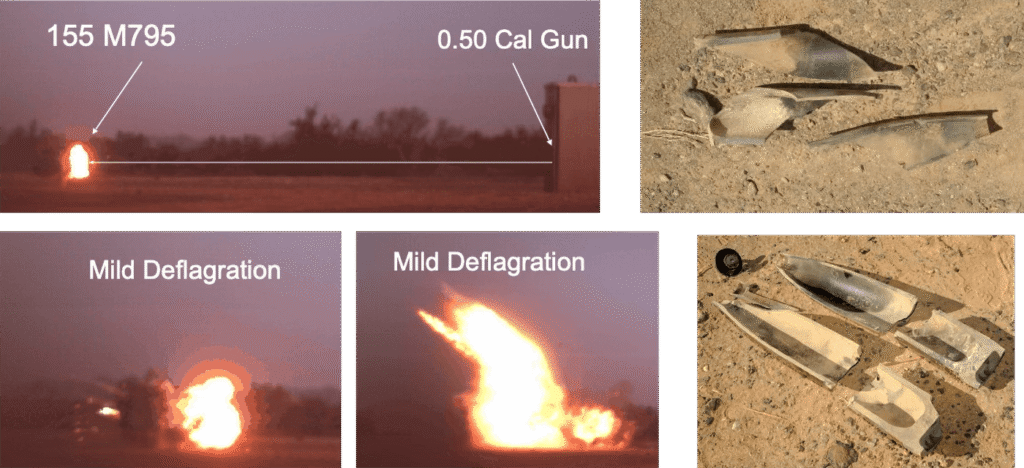
Our C-IED and EOD technology focused on lightly and heavily cased ordnance. For heavily cased munitions, e.g., 155mm artillery, we developed a family of 0.50Cal cargo projectiles that contained different RM to produce a mild deflagration. Forty-two tests against six different targets containing Comp-B, TNT, C4 and PBXN-5 were conducted at Yuma Proving Grounds (YPG). We achieved a 100% success rate during fourteen (14) shots against 155 M795 shells as illustrated below and matured the 0.50Cal rounds to a TRL6. Lessons learned during this period are currently being applied to new underwater threats in our current MCM programs.
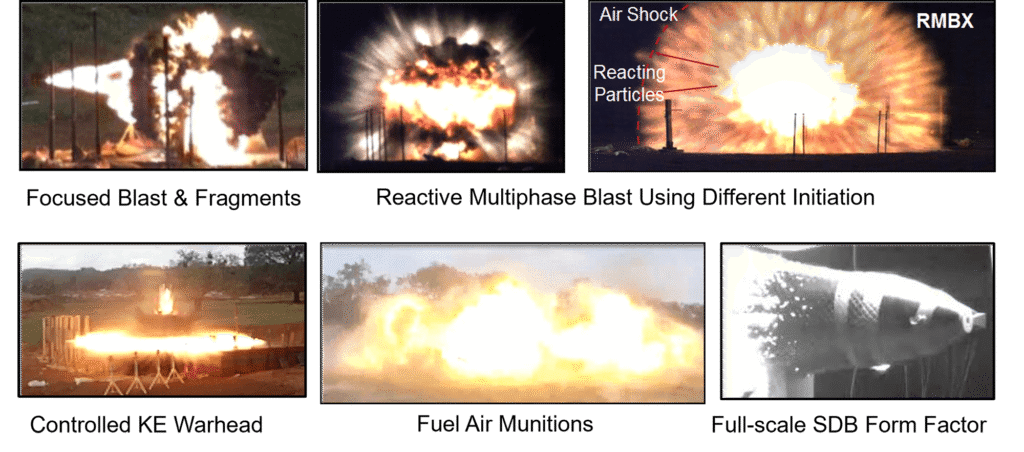
The second focus was driven by the need for a new generation of warheads for MOUT that provide control of fragment velocity and direction and enhanced blast. The objective was to reduce collateral damage, but it also results in a smaller warhead, since the output is focused on the target. This legacy technology has special application for today’s ‘drone” warhead designs. Examples of EMPI’s prototype warhead outputs are shown in the series of photos. The full-scale small diameter bomb (SDB) form factor (lower right) was tested at Eglin AFB.
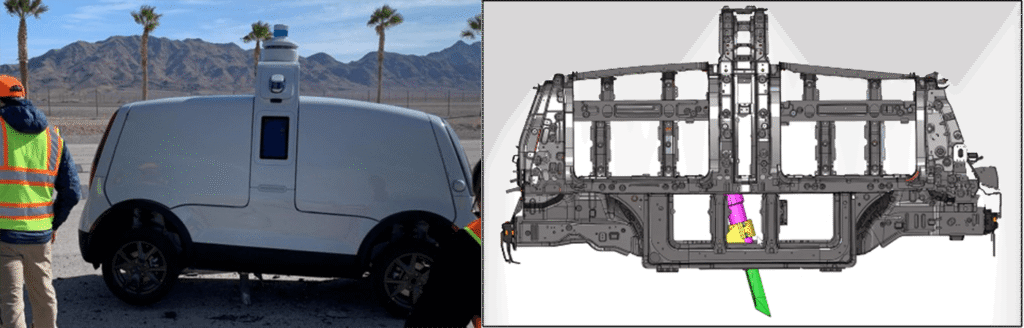
Stage 2 began about 2014 and was the era of collaboration and partnerships focused on large-scale Technology Demonstrators tested under a relevant environment. We built a 278-acre test site on a retired graphite mine to allow for more efficient execution of larger, more complex systems. Three (3) multi-year programs of note were: (a) Conformal Fragment Panel (CFP) warhead for high-speed missile ground attack; (b) Ballistic Anchor to secure Blue Origins New Glenn heavy lift rocket booster to a floating sea-based platform; and (c) Super Stop system to arrest NURO’s autonomous delivery vehicle in 6ft regardless of road conditions.
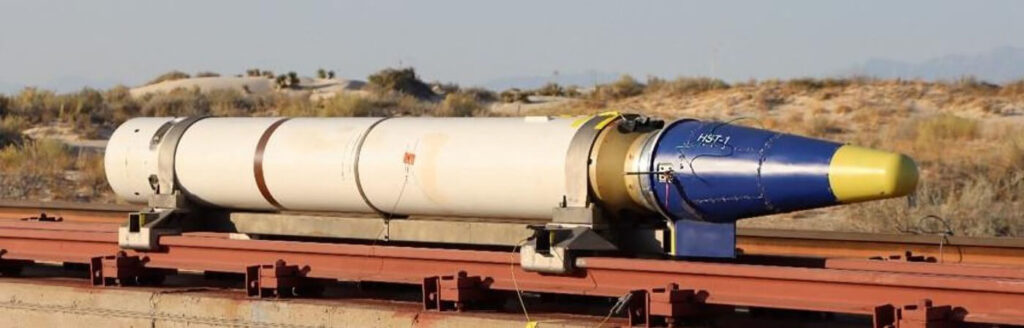
The CFP warhead program culminated in 2020 with two full scale rocket sled tests at Holloman AFB. The nose cone shown in blue and yellow contained CFP warhead, which EMPI fabricated and shipped to Holloman. After the Air Force paused the CFP warhead program, EMPI received a SBIR Missile Defense Agency (MDA) program to demonstrate the CFP warhead for potential ballistic missile interceptors. This CFP warhead is designed to produce a forward focused fragment pattern, which is ideal; for the current tactical and ballistic missile threats. In the NURO Super Stop program we demonstrated a ballistic plow fired from under the vehicle to engage the road subsurface and bring the vehicle to a full stop. The full up test on their vehicle was conducted at the Las Vegas Motor Speedway.
Stage 3 began about 2018 when DoD pivoted toward the Indo-Pacific. EMPI leveraged our legacy technology and engineering data to quickly develop Ballistic, Thermal Jet, and Shaped Charge Jet (SCJ) Effectors for underwater offensive and defensive applications. Our Effectors and various energetic devices are critical to three Programs of Record (POR). We will be producing an energetic device for one high-visibility POR with a planned IOC in FY2027. These programs are run at a high classification level. Very recently we modified one of our Effectors and conducted a test on a small semi-autonomous UAS for a potential customer in an active combat zone.