
Reactive Materials
Reactive Materials (RMs) liberate energy by rapid combustion and can provide improved target damage and in some cases offer safety advantages compared to explosives. EMPI has developed enabling technology, prototypes, and products with a clear competitive advantage to capitalize on this opportunity.
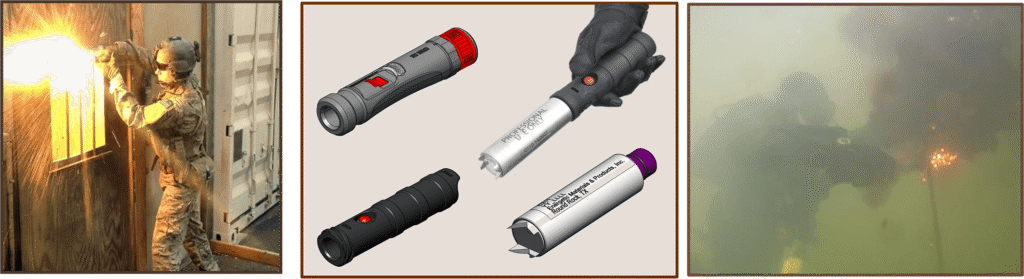
The Thermal Erosive Cutting (TEC) Torch is a handheld; thermal breaching tool designed for simple and quick deployment and is used primarily by US and UK military. The images show an Army Ranger cutting metal bars (left), sample cartridge and handles from TEC Torch product portfolio (center) and a diver cutting a cable (right). The TEC Torch is protected by two USPTO patents and SBIR Phase III Data Rights.
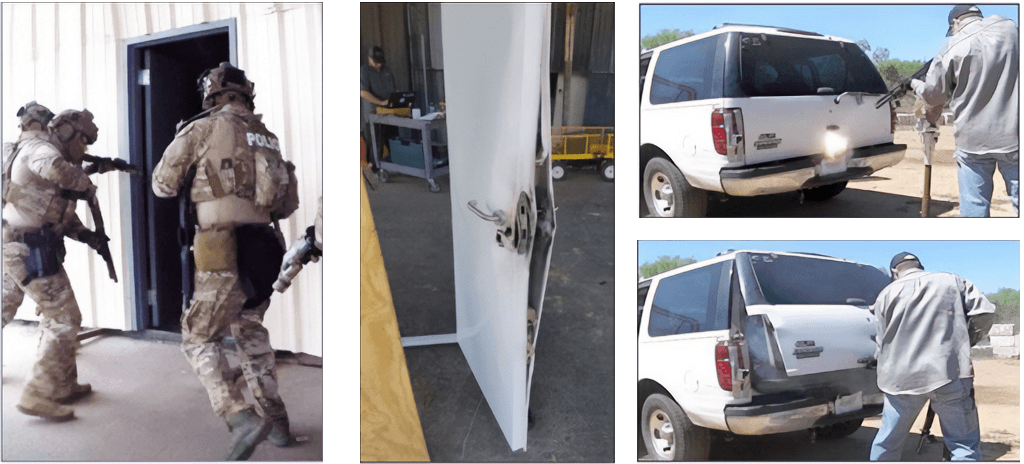
A second application is our RM12GAround for ballistic breaching. This combines kinetic and chemical energy for quicker and more efficient breaching relative to inert, metal powder cartridges. Our design is a frangible high-density composite surrounding an impact-initiated RM that rapidly deforms the structural components and opens the door. The ignition and reaction rate are tailored for maximum target damage.
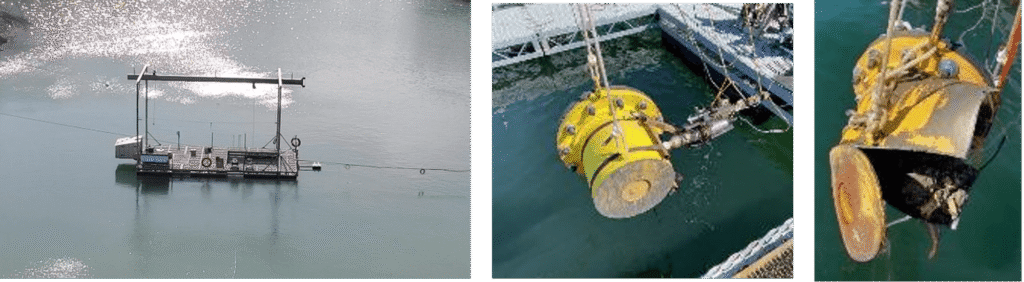
Most recently, EMPI has been advancing a unique Structural Reactive Material (SRM) known as ICEPK with compressive strength and density similar to steel. It will initiate under ballistic impact making it a good candidate for warhead preformed fragments. Currently, we have success in mine countermeasure (MCM) applications where an ICEPK projectile perforates a mine case and combusts the HE fill subsequently defeating the mine with minimal surface expression. The photos are from a typical MCM test at our quarry lake showing mobile platform (left) surrogate mine being lowered through moon pool (center) and post-test image (right)
Ballistic Systems
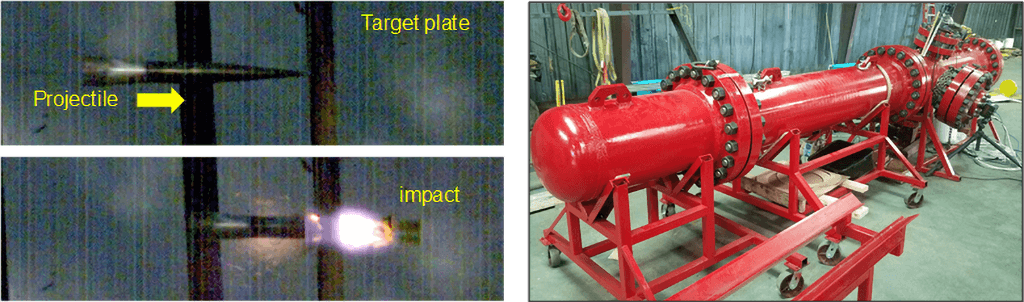
EMPI’s ballistic systems (launcher and launch package or projectile) were originally developed primarily for C-IED and EOD applications. Recently the expertise has been used to develop hydroballistic systems for defensive (MCM) and offensive applications. Testing typically involves quantifying flight stability, launch survival, gun recoil attenuation and target engagement. The photos show a 20mm cargo supercavitating projectile impacting steel plate (left) and hydroballistic tank capable of testing HE rounds in simulated ocean depths of >1000ft.
Energetic Systems
EMPI has reduced to practice different prototype munitions to deliver target specific effects. They achieve different outputs by a unique arrangement of the components and their composition, referred to as the warhead architecture, which implies a combination of: (a) different energetic material compositions; (b) unique geometry (location, configuration and mass) of the energetic materials; and (c) initiation stimulus (shock strength, duration and location), including the use of shock/shock interactions or Mach disk formation.
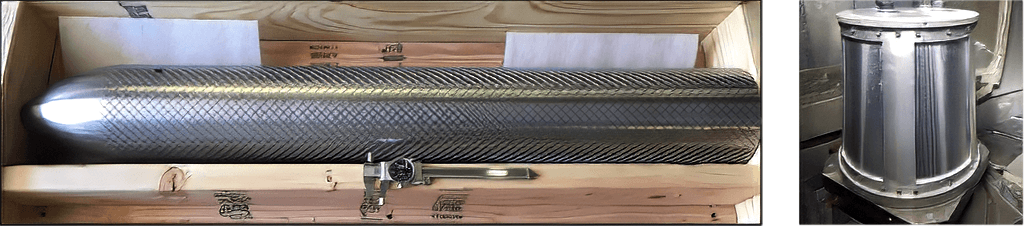
Our team has experience in best in class design and CAD to transition ideas into reliable devices. We have developed a database of trusted: CNC shops for complex surface or high-volume jobs, additive manufacturing providers, specialty shops for needs such as gun drilling, aluminum and titanium welding operations, heat treat and coating operations, and special material suppliers for graphite, tungsten, and titanium alloys for large-scale jobs. Examples of full-scale hardware fabrication in the photo are for a small diameter bomb form factor test article (left) and missile nose cone for (right) for the CFP.
In summary, our engineers have specialized knowledge and expertise in reactive materials; ballistics; design and fabrication of energetic hardware; and testing. We employ contractors for shock physics and computational fluid dynamic (CFD) simulations. We have a proven track record of maturing technology from: concept, design, and analysis; to prototype and products with unparalleled time and cost efficiency.